Commercial roof replacement cost in the Shingle Springs and El Dorado Hills corridor varies significantly from Sacramento valley pricing, and property owners who use valley-based estimates often face budget shortfalls once El Dorado County permitting fees, hillside material staging, and Class A fire-resistance assembly requirements enter the picture. Roof Geeks provides California-specific commercial roofing estimates grounded in local labor rates, material specifications appropriate for Climate Zone 3, and the actual code requirements that apply to each property.
Get a commercial roofing estimate built around your building, not a national average.
Key Takeaways
- Replacing a commercial roof in this market typically runs higher than comparable Sacramento valley projects due to hillside staging and county permitting requirements.
- El Dorado County commercial re-roofing permits generally add $500 to $2,500 or more to total project cost depending on valuation.
- Properties in High or Very High Fire Hazard Severity Zones require Class A fire-resistance assemblies, which affects material selection and per-square-foot pricing.
- TPO and EPDM systems in the foothills should be specified at 60-mil minimum thickness to handle the region's severe thermal swings.
Why Commercial Roofs Cost More to Replace in the El Dorado County Foothills
A commercial roof that has passed its service life does not fail gradually in the foothills climate. Summer heat regularly exceeding 100°F combined with winter freeze-thaw cycling accelerates membrane degradation, and a single compromised point of entry can drive water into structural decking, insulation, and interior systems fast enough to turn a $40,000 replacement into a six-figure structural loss. That thermal stress, discussed once here in full, is the underlying reason foothill pricing and specifications differ from the valley floor throughout this guide.
Roof Geeks performs full roofing system assessments and complete replacements throughout the greater Sacramento region, including retail centers, office parks, and light-industrial buildings along the Highway 50 commercial corridor. Roof Geeks operates as a licensed California roofing contractor, and every estimate is prepared under that CSLB license, verifiable through the Contractors State License Board before any contract is signed. This guide gives property owners a practical framework for evaluating a commercial roofing estimate in El Dorado County and planning capital expenditures accurately, using Northern California labor rates, local permitting realities, and system-specific pricing rather than national averages that do not reflect this market.
What Does Commercial Roof Replacement Cost Per Square Foot in California?
Commercial roofing cost per square foot in California ranges from $6 to $30 or more, depending on the roofing system, building size, and regional labor rates. Projects in El Dorado County trend toward the mid-to-upper end of that range because of permit processing timelines and fire-resistance assembly requirements tied to Wildland-Urban Interface zone classifications.
The five roofing systems below represent the most common replacement options our team installs across the area. Each range reflects installed cost, including materials, labor, and standard flashing work, but excludes permit fees, tear-off of failed assemblies, and structural repairs.
TPO Membrane Roofing: $7 to $14 per Square Foot
TPO is a single-ply thermoplastic membrane with heat-welded seams and Energy Star-rated options that satisfy Title 24 cool-roof compliance for Climate Zone 3. It is the dominant flat roof replacement system on low-slope commercial buildings across the foothills, and our installers specify a 60-mil minimum thickness to withstand the summer heat and winter freeze-thaw cycling described above, which shortens the life of thinner membranes.
EPDM Rubber Membrane: $6 to $12 per Square Foot
EPDM is a vulcanized rubber membrane installed fully adhered or mechanically fastened, with a service life of 20 to 30 years under normal conditions. It performs best on commercial buildings with minimal rooftop equipment penetrations. The same 60-mil minimum applies here as it does for TPO, with an added reason at elevation: the higher-intensity UV exposure in the foothills oxidizes and hardens the rubber surface faster than at sea level, so the extra thickness preserves flexibility over the membrane's life.
Modified Bitumen / Torch Down: $5 to $10 per Square Foot
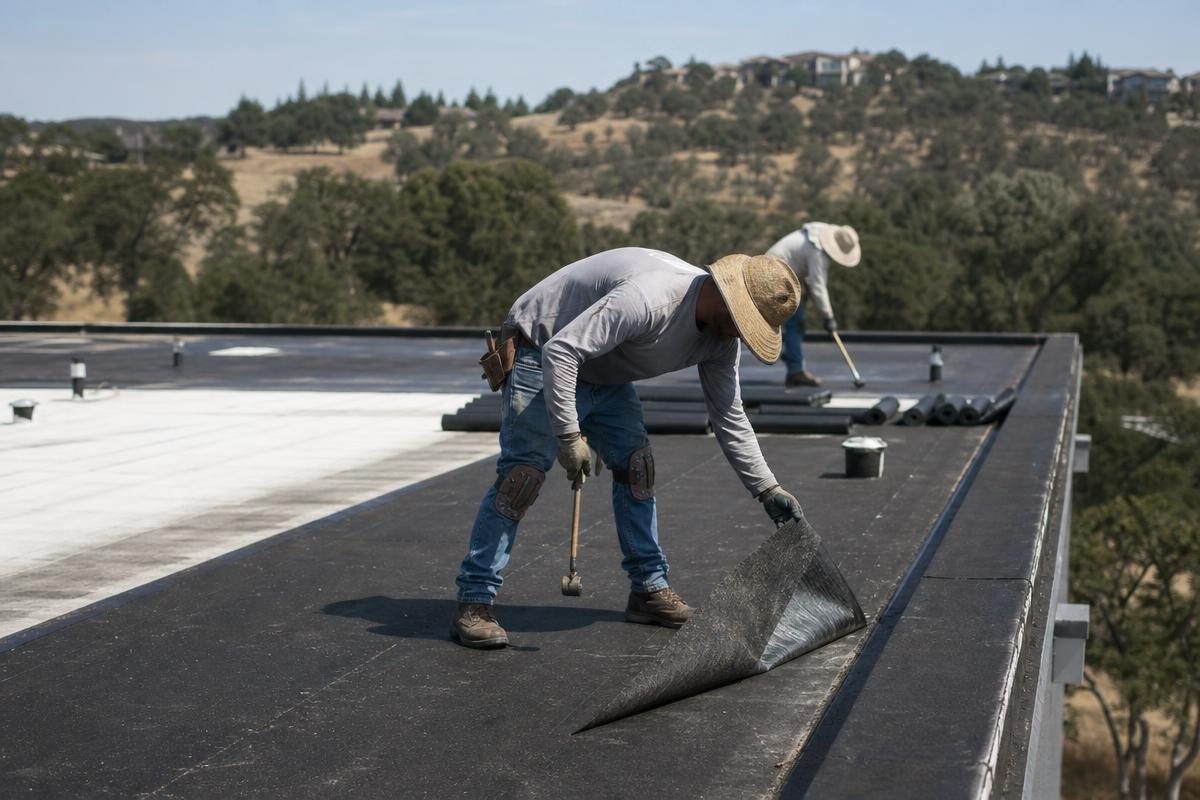
Modified bitumen systems use SBS or APP polymer-modified asphalt applied in a two-ply assembly, either torch-applied or cold-applied. Torch-applied systems require fire watch protocols and face additional permitting scrutiny in WUI zones; property owners should review the WUI fire-resistance requirements for El Dorado County properties before selecting this system.
Standing Seam Metal Roofing: $12 to $25 per Square Foot
Standing seam metal uses Galvalume or Kynar-coated steel panels with concealed fasteners and a lifespan of 40 to 60 years. It is increasingly specified on commercial properties in the foothills where a Class A fire-resistance assembly is required under California Building Code Section 1505, and the higher upfront cost is frequently offset by reduced maintenance cycles over the building's life.
Built-Up Roofing (BUR): $5 to $9 per Square Foot
BUR consists of alternating layers of bitumen and reinforcing felt, surfaced with gravel or a cap sheet, and carries the lowest installed cost of any system listed here. The dead load added by a BUR assembly requires a structural review on older commercial buildings, a step our team includes in the pre-bid assessment before any BUR replacement is quoted.
How to Calculate the Total Cost of a Commercial Roof Replacement
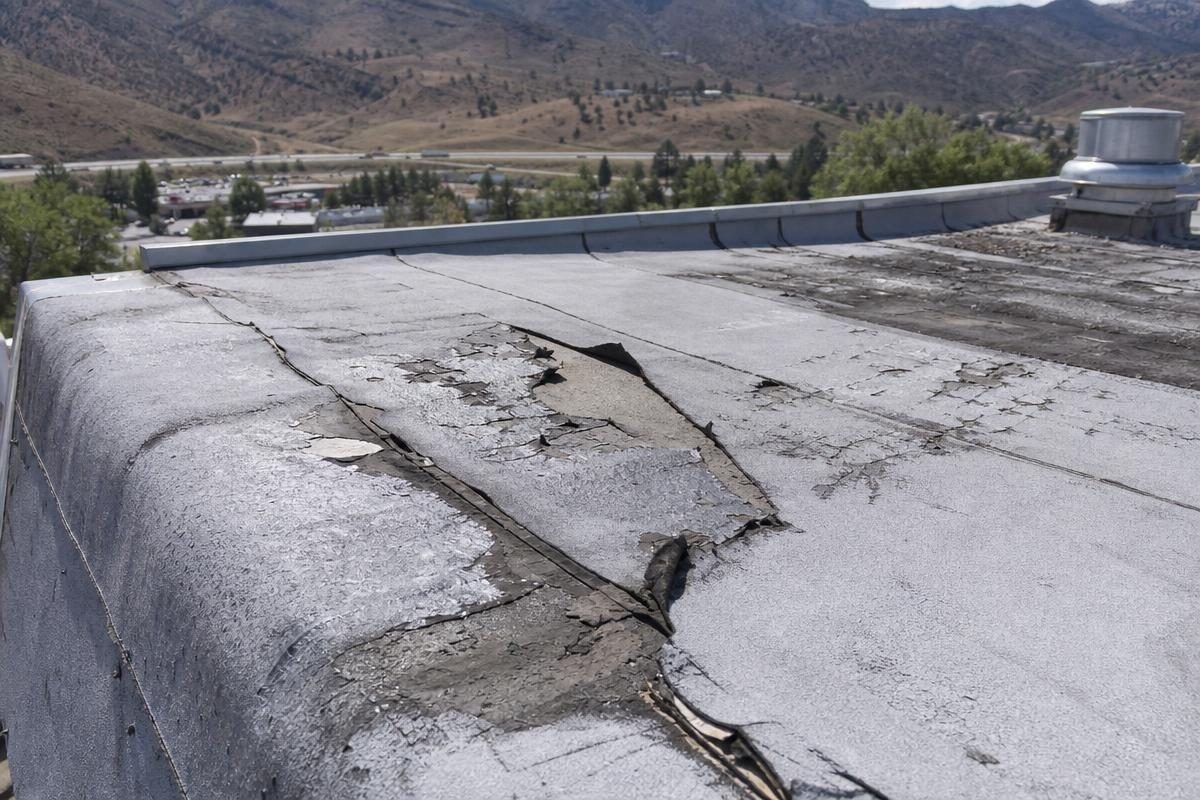
Property owners who receive a single lump-sum quote have no reliable way to verify accuracy or catch scope creep once construction begins. A line-item breakdown, built from four discrete calculation steps, is the only format that holds a commercial roofing estimate accountable from bid to final invoice.
Step 1: Measure the Roof in Squares
Divide the total roof area in square feet by 100 to get the number of squares, the unit commercial roofing is priced in. A 10,000 square foot flat roof equals 100 squares. Low-slope commercial properties in this corridor typically fall between 20 and 200 or more squares, so even a small measurement error compounds quickly into a significant cost miscalculation.
Step 2: Calculate Material and System Cost
Material cost per square is a stack of components, not a single number: polyiso or EPS insulation board, a cover board, and the membrane itself. Climate Zone 3, which covers this corridor east of Sacramento, requires insulation values between R-20 and R-30 under Title 24, and that insulation thickness directly drives material cost before a single fastener is set.
Step 3: Add Tear-Off, Deck Repair, and Disposal
Tear-off of an existing single-ply membrane typically adds $1 to $2 per square foot to the project total. Multi-layer built-up roofing tear-off runs $2 to $4 per square foot. Deck repair, when deteriorated OSB or plywood is found beneath the old system, adds $3 to $6 per square foot for affected areas only. Seasonal moisture cycling accelerates hidden deck deterioration, so properties here should budget a contingency line for deck replacement rather than treating it as a surprise. Our technicians flag these conditions during inspection, and property owners can read more about roofing material durability in the Shingle Springs area to understand how system selection affects long-term deck protection.
Step 4: Include Permitting and Inspection Fees
El Dorado County Development Services Department issues commercial re-roofing permits, and those fees range from $500 to $2,500 or more depending on project valuation. Properties within a High or Very High Fire Hazard Severity Zone also require a fire-resistance assembly submittal, which can extend the plan-check timeline. Any estimate that omits permit fees is incomplete, and that omission will surface as an unexpected cost at the worst possible point in the project schedule.
Not sure what your building actually needs? Schedule a free commercial roof assessment with our El Dorado Hills team.
Call Us
What Makes a Commercial Roof Replacement More Expensive in El Dorado County?
Material cost per square foot is only one variable in a replacement estimate. Properties along the US-50 corridor east of Sacramento face several site-specific cost escalators that routinely push total project cost above the California average, and property owners comparing quotes from Rancho Cordova or West Sacramento should expect those differences to show up in the numbers.
WUI Zone and Fire-Resistance Assembly Requirements
Commercial parcels in the foothills frequently fall within State Responsibility Area or High/Very High Fire Hazard Severity Zone classifications, triggering Class A fire-resistance assembly requirements under California Building Code Section 1505. Upgrading to a rated assembly, whether a fire-rated TPO membrane, standing-seam metal panel, or fire-rated modified bitumen, adds $1 to $3 per square foot over non-rated equivalents. On a 10,000-square-foot roof, that single code requirement can add $10,000 to $30,000 to the total. Our team reviews fire hazard mapping for every commercial property before finalizing a specification; for more background, see our overview of WUI roofing requirements for El Dorado County properties.
Penetrations, Flashings, and Rooftop Equipment
Each HVAC curb, exhaust fan, conduit penetration, or parapet wall transition requires custom step flashing, counter-flashing, or curb flashing fabricated to fit the specific condition. Labor and material for a single penetration typically runs $150 to $600. A commercial building with 10 or more rooftop penetrations can see total flashing costs exceed $5,000 before a single square foot of membrane is installed.
Access, Staging, and Hillside Site Conditions
Hillside commercial parcels along the corridor may require crane lifts or extended material staging areas that flat-site valley properties simply do not. Our crews account for this during site assessment; when crane access is required, property owners should budget an additional $1,500 to $4,000 in mobilization and staging costs. That cost driver does not appear on a comparable quote for a flat-grade property in Sacramento or Elk Grove.
Deck Condition and Moisture Damage
Seasonal moisture cycling accelerates saturation of OSB and plywood decking beneath aging membrane systems. Saturated decking cannot hold fasteners to manufacturer-specified pull-out values and must be replaced before any new roofing system is installed. Our technicians use core sampling and infrared moisture scanning during the assessment phase to quantify deck damage precisely, so the estimate reflects actual replacement scope rather than a field guess made after tear-off begins.
What Does a Commercial Roofing Estimate from Our Team Include?
An estimate that lists only a total project price gives the property owner no basis for comparison and no protection against scope creep once work begins. Roof Geeks provides fully itemized written estimates that separate material costs, labor, tear-off and disposal, deck repair allowances, and permitting fees into distinct line items, so every cost driver is visible before a contract is signed.
Drone Inspection and Photographic Documentation
Estimating a commercial roof replacement without a thorough inspection of the full membrane surface produces inaccurate numbers. Our technicians conduct a drone roof inspection before preparing any estimate, capturing high-resolution photographs of field membrane condition, seam integrity, flashing terminations, and drainage points across the entire roofing system.
That photographic record becomes part of the written estimate package, giving the property owner a documented baseline that supports insurance claims, warranty registration, and future maintenance planning. Customers including David and Chris have specifically noted in our 113 Google reviews that our team did not recommend unnecessary work, a standard our inspection process is designed to enforce.
Itemized Scope of Work
Generic line items create disputes. Each estimate our team prepares specifies the roofing system type and manufacturer, insulation R-value and board type, membrane thickness such as 60-mil TPO versus 45-mil, fastener pattern, flashing material specifications, and the applicable warranty tier.
For commercial properties along the US-50 corridor in El Dorado County, the estimate also identifies site-specific cost factors such as crane lift requirements on hillside parcels, permit fees through the El Dorado County Development Services Department, and any Class A fire-resistance assembly requirements triggered by Fire Hazard Severity Zone designation. A complete estimate that a property owner can actually use for comparison must include all of these variables, not just a bottom-line number.
Manufacturer Warranty Coverage
Manufacturer-backed warranties on commercial systems range from 10 to 30 years depending on the system selected and membrane thickness specified. Qualifying for those warranties requires certified installation crews and third-party inspection at project completion, both of which our team coordinates as part of the project close-out process.
Want an itemized estimate that actually breaks down your project? Call our El Dorado Hills team at (916) 888-7663 to schedule an inspection.
Is a Commercial Roof Warranty Worth the Added Cost?
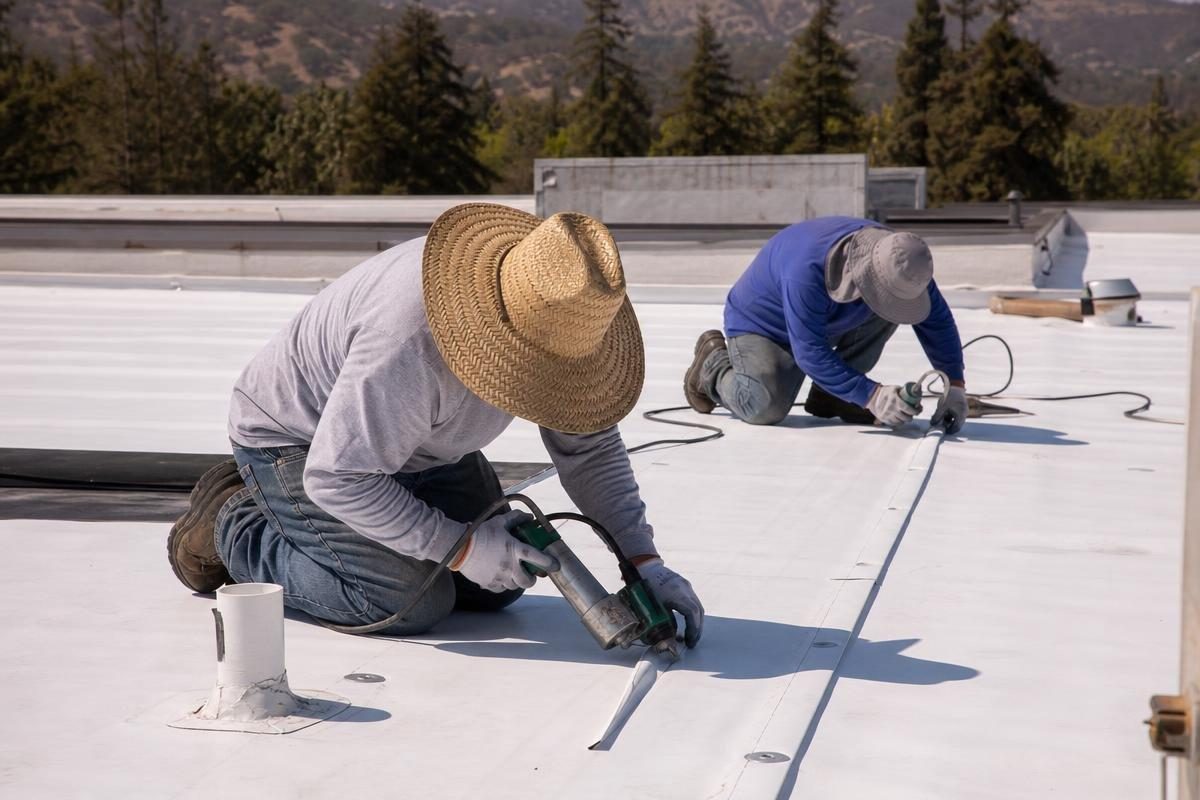
A commercial roof installed without manufacturer-backed warranty coverage leaves the property owner fully responsible for every repair cost if the membrane fails before its expected service life ends. In the foothills, the thermal stress described earlier is not theoretical: it is one of the leading drivers of seam separation and membrane failure in this climate band, and a property without warranty protection absorbs every dollar of that repair.
Material-Only vs. Full-System (NDL) Warranty
A material-only warranty covers manufacturing defects in the membrane itself. It excludes installation errors, flashing failures, seam separations caused by improper application, and any labor cost to remediate a covered defect. A full-system No Dollar Limit warranty covers the entire roofing assembly, including labor to repair any covered failure, for a term typically ranging from 15 to 25 years.
That coverage upgrade adds approximately $0.50 to $1.50 per square foot on 60-mil TPO and 80-mil EPDM systems. On a 10,000 square foot commercial roof, that is $5,000 to $15,000 added to the TPO roof replacement cost upfront, in exchange for eliminating out-of-pocket repair exposure across the full warranty term. For properties in this climate band, where 45-mil membranes common in milder coastal California markets are undersized, the full-system warranty also enforces the correct specification. Our installers apply these systems to manufacturer-specified requirements so each project qualifies for full-system coverage.
Workmanship Warranty: What to Verify Before Signing
A contractor's workmanship warranty is only enforceable if the contractor holds an active California contractor's license and carries current general liability and workers' compensation insurance. A verbal commitment carries no legal weight. Before signing any contract, the property owner should request the contractor's license number, verify it through the Contractors State License Board, and confirm that the certificate of insurance names the property.
For more on how roofing material durability holds up under foothill conditions, see our roofing material durability guide for this region.
Local Conditions That Affect Commercial Roofing Costs in Shingle Springs
Property owners who rely on national cost averages to budget a commercial re-roofing project in this market routinely come up short. The foothills climate, local code requirements, and site access conditions push project costs well above what generic estimating tools project.
Elevation, Climate, and Thermal Cycling
The US-50 corridor sits at roughly 1,200 feet, placing commercial properties in a climate band that delivers summer highs above 100°F, a UV index that accelerates membrane oxidation, and winter temperature swings that stress roofing seams and step flashing joints. That thermal cycling is the primary reason 45-mil TPO and EPDM membranes common in milder coastal markets are undersized here. Our installers specify a minimum 60-mil membrane thickness on every low-slope commercial roofing system in this market, and that specification is reflected in the material line of every estimate we produce.
Hillside commercial parcels along the corridor may also require crane lifts or extended material staging that flat-site properties in the valley floor do not. That mobilization cost is a real budget line, not a rounding error.
Title 24 Cool-Roof Requirements in Climate Zone 3
Commercial properties here fall within California Climate Zone 3, and Title 24 Part 6 sets minimum solar reflectance and thermal emittance values for low-slope roofing systems in that zone. A system that does not meet those thresholds fails building department inspection, which delays occupancy and adds re-inspection fees to the project cost. Energy Star-labeled TPO membranes and qualifying reflective coatings satisfy the cool-roof requirement. Our technicians confirm product compliance before any material is ordered, so the roofing system passes inspection on the first review.
Real Project Cost Context for El Dorado County
Commercial re-roofing projects in this area vary significantly based on scope. A straightforward single-ply membrane replacement on a clean, sound deck typically costs far less than a full tear-off with deck replacement, polyiso insulation upgrade, and 60-mil TPO installation on a larger retail or office-park footprint with fire-resistance assembly requirements. Contact Roof Geeks for a project-specific estimate. Storm damage is one of the most common triggers for full replacement in this climate; property owners dealing with that scenario can review our guidance on insurance claim support after storm damage before requesting an estimate. Every project in this market is priced against actual Northern California labor rates and current material costs, not national averages that do not reflect local conditions.
Frequently Asked Questions
What Does Commercial Roof Replacement Cost in Shingle Springs?
Commercial roof replacement cost in this market typically runs $6 to $25 or more per square foot, depending on the roofing system specified, deck condition, and fire-resistance assembly requirements. Mid-size properties in the 5,000 to 15,000 square foot range generally carry total project budgets between $45,000 and $150,000, with WUI zone assembly requirements and deck repair being the two most common cost escalators.
Which Roofing System Offers the Best Value for a Low-Slope Commercial Building?
TPO membrane is the most widely specified cost-effective system for low-slope commercial buildings in Northern California, with installed TPO roof replacement cost ranging from $7 to $14 per square foot at 60-mil thickness. TPO meets Energy Star cool-roof requirements for Title 24 compliance and carries a 20 to 30 year service life under standard conditions. EPDM is a close alternative for buildings with minimal rooftop equipment and limited foot traffic.
How Long Does a Commercial Roof Replacement Take in El Dorado County?
The installation phase on a 10,000 square foot commercial roof typically runs 3 to 7 business days. Permit issuance adds 2 to 4 weeks before construction can begin, and properties in fire hazard severity zones requiring a fire-resistance assembly submittal referencing an ICC Evaluation Service listing may extend that timeline further.
Is a Building Permit Required for Commercial Re-Roofing in El Dorado County?
A building permit is required for commercial re-roofing in this jurisdiction. The application must include a roofing system description, insulation R-value documentation, and for properties in fire hazard zones, a fire-resistance assembly submittal. Permit fees for commercial projects typically range from $500 to $2,500 or more depending on project valuation. Our team prepares the permit package as part of the estimate process. For more background on fire-assembly requirements in this area, see our overview of WUI roofing requirements for properties in the foothills.
When Should a Commercial Roof Be Replaced Rather Than Repaired?
A roofing system showing active moisture infiltration or membrane delamination across more than 25% of its surface area is a replacement candidate, not a repair candidate. Repair costs applied to a failing field membrane rarely extend service life by more than 2 to 3 years, making full flat roof replacement the more defensible financial decision at that stage.
How Does Our Team Price a Commercial Roofing Estimate?
Our team prepares itemized estimates following drone inspection and core sampling, separating material costs, labor, tear-off and disposal, deck repair allowances, and permitting fees into distinct line items. The estimate reflects actual measured roof area, specified system components, and local permitting requirements, not a national per-square-foot average applied to a building footprint.
Call Roof Geeks at (916) 888-7663 to schedule a drone inspection and itemized commercial roofing estimate for your property. Our team serves commercial property owners across the greater Sacramento region, from Cameron Park and Folsom to Rancho Cordova and Roseville. Get a written, line-item estimate that reflects your actual roof, your actual deck condition, and your actual permitting requirements.
Ready to Get Started with Roof Geeks?
Call (916) 888-7663 to speak with our team directly. We're ready to answer your questions, walk you through your options, and help you find the right solution for your needs. Whether you're just starting to plan or ready to move forward, we'll make the process simple and stress-free.
Reach out today and let's talk about how we can help.